Thursday, March 14, 2019

"Kiss Me, Kate" Roundabout Theatre Company Studio 54 (through June 2, 2019)


Kelli O'Hara and Will Chase star in Cole Porter's classic musical "Kiss Me, Kate," now being revived by the Roundabout Theatre Company on Broadway (Photo by Joan Marcus)

          Kelli O'Hara and Will Chase  (photo credit: Joan Marcus)


Another opening, another revival of “Kiss Me, Kate” or perhaps re- titled “Kick Me, Kate,” as this is what will come to mind as you watch Kate (Kelli O’Hara) give Petruchio’s (Will Chase) derriere what for and more in this rowdy and rousing and also slightly finessed version courtesy of the Roundabout Theatre Company. The original play-within-a-play book by Bella and Sam Spewack was ingeniously fused with Shakespeare’s “Taming of the Shrew may have a slightly creaky resonance during these Me-Too days of late, but director Scott Ellis has remained true to the Spewaks and composer Cole Porter  in more than his fashion. This, by focusing on what is simply never out of date: the funny book, the great score and then giving choreographer Warren Carlyle ample opportunities for his dance designs and the dancers who stop the show.

The question for seasoned musical theater fans is how this revival stacks up against the one produced twenty years ago in which Brian Stokes Mitchell memorably contended with Marin Mazzie’s more full-frontal attacks. To say it straight out: It’s a damn good show but no rival to its predecessor. 

Even as this musical opens with the familiar “Another Op’nin, Another Show,” you sense it won’t be just another opening. It begins quietly with one stagehand entering the empty backstage area, followed by more backstage crew. As one voice is added to the other, the exuberant song steadily builds in excitement. The crew is soon joined by members of the acting company, the dancers and singers and, finally, the principals, all checking out their out-of-town-theater and warming up their bodies.

There is little doubt that “Kiss Me, Kate” (first produced to acclaim in 1948) is one of the great ones. It is filled to the brim with Porter’s coolest melodies, wittiest lyrics and certainly in this staging dancing that is emphatically calculated to be “Too Darn Hot.” This highpoint is set in the alley behind the theater on a hot night following a performance and provides a showcase for the dancers to switch gears from limp and languid to lusty and loose.

“Kiss Me, Kate” is the kind of smart and raucous musical comedy that would seem to have vanished forever. The Spewacks fashioned the cleverly entwined plot (supposedly inspired by the real-life thespian duo of Alfred Lunt and Lynn Fontanne) to parallel the personal problems of the tempestuous Lily Vanessi and the vain Fred Graham, a forever battling ex-married showbiz couple, with the characters they play - Katherine and Petruchio - in “The Taming of the Shrew.” The failing of some magnitude in this production is the lack of chemistry (and not for lack of trying) between O’Hara and Chase.

O’Hara is sublime both in voice and in performance as she embraces Kate as a snarling hellcat and later as a beguiling heroine in her final slightly tweaked aria “I’m Ashamed That People (substituted for Women) Are So Simple,” inspired by Katharine’s sly lecture the ladies. It will evidently sooth the souls of those who are easily offended by history. Chase is certainly good-looking enough and he sings well enough as he assumes Petruchio’s obligatory macho countenance throughout. However, his  egotistical poses in the prose song “I’ve Come to Wive It Wealthily in Padua” only point out that Chase is simply not O’Hara’s equal when it comes to creating magic or magnetism on the stage.

There is a lulu of a subplot that involves a flirtatious actress (Stephanie Styles  making a terrific Broadway debut) and her gambling boyfriend (Corbin Bleu). They untypically complement each other and are a standout in “Why Can’t You Behave,” and “Always True to You (in my fashion).” This powerhouse couple display a magnetism that is missing from the leads.
 
Just as we might expect the company’s antics in old Padua, cued by the humorously repetitive “We Open in Venice,” to provoke laughter (it does) we also expect the two gangsters, as played by John Pankow and Lance Coadie Williams to stop the show with “Brush Up Your Shakespeare” (they don’t). I can only assume that two good actors were poorly directed. No brush-up is needed to appreciate the artistry of designer David Rockwell, whose settings are a beautiful contrast of on-stage fantastical and back-stage functional. The  costumes by Jeff Mahshie are snappy and silly in keeping with the spirit of the show. If providing an audience with a generally good time was the goal, “Kiss Me, Kate” delivers.

Wednesday, February 20, 2019

“Merrily We Roll Along” Fiasco Theatre for Roundabout at the Laura Pels Theatre, 111 W. 46th Street through April 7, 2019

Courtesy of Joan Marcus
From left: Manu Narayan, Jessie Austrian and Ben Steinfeld in 'Merrily We Roll Along'
Theat


It has become a pleasure for me to look forward to performances by The Fiasco Theater, the company that created something like minimalist magic with Shakespeare’s “Cymbeline,” and then with even more unpretentious inventiveness with the challenging Stephen Sondheim musical “Into the Woods,” each to wondrous results. Am I not surprised that they have gone right back to Sondheim to tackle his difficultly structured 1981 musical “Merrily We Roll Along,” but this time with the production resources of the Roundabout Theatre Company. This musical about idealism gone astray has been a test for many theater groups since it first made the rounds.

Although it had an original run of only two weeks, “Merrily” boasted a memorable score that would become a legend in its own time. Sardonic as it was, George Furth’s book (based on a 1934 play by George S. Kaufman and Moss Hart) had a hard time marrying itself to the often flinty lyrics of the score, that included such melodic treasures as “Good Thing Going,” “Not a Day Goes By,” “Old Friends,” and “Our Time.”
The program notes reminds us that Fiasco explored and combined earlier versions of the script--a good idea for a very good result. I might say that this version has been scaled down to a streamlined one act but not terribly diminished by this paring. The notes also remind us of the lengths that Sondheim and Furth went to solve the show’s problems when it first opened, the first being to clarify a problematic plot device that keeps the action going backward in time, instead of forward...just as did the original play. 

Like the play, the musical focuses on a talented composer willing to compromise his professional and personal ethics in pursuit of success and without regard for its effect on his friends and collaborators. Tainted throughout by betrayals and tinged with a bittersweet perspective, the musical hits us in hard in our gut as we follow the path of friends once life-long friends who once shared the same optimism and romantic ideals.

This production, under the fine and get-right-to-it direction of Noah Brody, boasts a more awesome frame than Fiasco is usually afforded. The setting designed by Derek McLane suggests a large warehouse of antiquities and collectables and is notable for its floor to ceiling shelving. It pleases the eye if it doesn’t necessarily add any corroborative value to what is being performed within it. I admit that I may have missed the message. 

The players, however, are terrific in their roles as expected and express the trenchant realities of their characters. This, as I also admit this company is not noted for its singers. In this case, the singers were merely adequate but also singularly impressive in their interpretive abilities. Watching the mix of jaded and naive characters make those wrong turns, as they grow younger over the musical’s regressing 20-year span, may just break your heart.

Although I choose to not single out each of the six terrific cast members, half of whom do more than double duty, I do feel compelled to say that Ben Steinfeld, as the egregiously self-serving centerpiece Frank, has a firm grip on his demanding role, something that can be said for all.

The costumes designed by Paloma Young and Ashley Rose Horton are often good for a laugh and the lighting design by Christopher Akerlind is as pro as one might expect. What one doesn’t expect and but get with this collaboration between Fiasco and Roundabout is a reminder of how Sondheim has always challenged us to ascend from any complacency with musical theater. In its smaller way, the Fiasco Theater does it all with heart.

Friday, January 25, 2019

"True West" Opened January 24, 2019 at the Roundabout Theatre Company at American Airlines Theatre


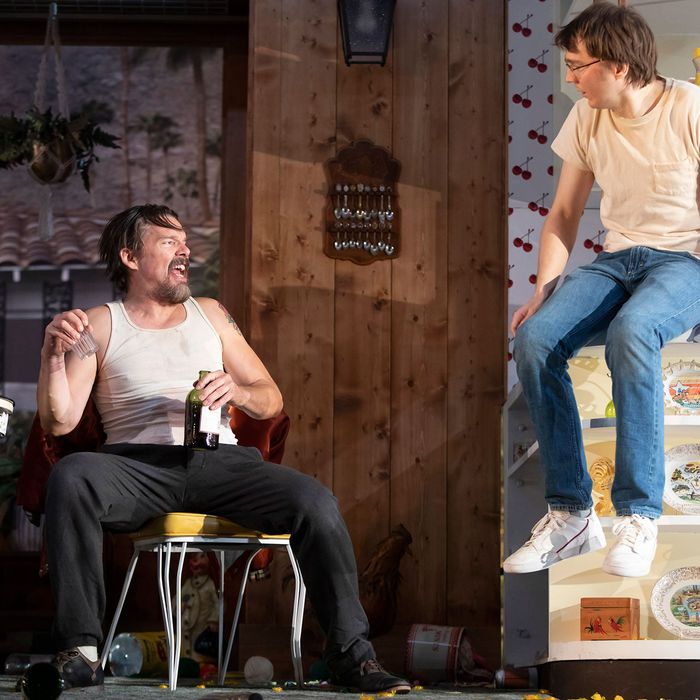
Ethan Hawke and Paul Dano
Photo credit: Joan Marcus


What is it about Sam Shepard's “True West” that packs a wallop each and every time I see it -- and that is four times if memory serves? Thank goodness I have kept my journals and notes going back to the 1980s for an occasional reference or simply a nostalgic rainy-day trip down memory lane. The first time I saw it was in 1980 at the Public Theater. It was a troubled production that disturbed its author sufficiently for him to disassociate himself from it. Troubled as that production may have been, even with the accomplished performing of Tommy Lee Jones and Peter Boyle as the alter-ego-ing brothers, it was an occasion that proved to be unforgettable for me. I realized with all the presumed troubles that it was an important work.
 
So how did that stack up against the Steppenwolf production that transferred in 1982 from Chicago to the Cherry Lane Theatre with its stars Gary Sinese and John Malkovich? And what about the play’s long-awaited Broadway debut in 2000 with the amazing Philip Seymour Hoffman and John C. Reilly who alternated the roles of the brothers? That version was acknowledged (also by me ) to have delved deeper into the play’s metaphysical core. So here we are in 2019 with a perfectly fine Roundabout Theatre production under the direction of James  Macdonald with Ethan Hawke, as Lee and Paul Dano as Austin.

Whether or not you acknowledge “True West” as the peak in Shepard’s impressive but notably unconventional canon, its story about two brothers who bait each other and then brutally battle each other is one of the more bizarre demonstrations of metamorphosis that the stage has seen. Shepard grittily dramatizes the creative process at work at its most primitive and humorous level. This humorous level is the one that seems to have captured the imagination and the interest of its players and directors over the years. Without losing the intensity of the plot’s meticulously crafted trajectory and without losing the play’s scrutiny of its characters, director Macdonald and his two stars Ethan Hawke and Paul Dano can be praised for the way the brothers’ inner demons appear exposed and vulnerable. 

An apparent slob and ne’er-do-well, except for some strong ethics regarding truth and honesty, Lee (Ethan Hawke) has returned after a five-month sojourn in the Mohave Desert to his mother’s house in a California suburb. Austin (Paul Dano) has been entrusted to stay at home and water their mother’s plants while he works on yet another pedestrian screenplay -- one he is trying to peddle to an apparently interested producer. Austin’s more clinical/pedestrian approach to his work is seen in direct conflict with Lee’s obsession to challenge his brother on his own turf. 

The sudden disruptive and often violent invasion of Austin’s world, and the eventual reversal of powers as Lee manipulates the clearly opportunistic film producer Saul Kimmer (a credible Gary Wilmes) leads to a struggle for power fraught with boozing, brawling and a general devastation of the home. As the donnybrook progresses so does the decimation of almost everything the brothers can get their hands on -- crushed beer cans, dinnerware, and appliances. Congrats to set designer Mimi Lien’s responsive kitchen-plus setting that takes the obligatory abuse in its stride. 

The now almost classic “pop-up toasters” scene is given all the latitude it needs to be ferociously funny. It’s almost difficult to recognize the bearded and slovenly dressed Hawke. This much lauded stage and film star succeeds brilliantly as the menacing, devilishly seedy Lee. In stunning contrast is Dano’s passive-aggressive performance as Austin -- from a slow burn into an inferno. Good work. Act II has the pleasure of having the always terrific Marylouise Burke portray Mom. Whether this is the true-est west of them all is debatable but as entertainment it is a winner.

Wednesday, January 9, 2019

“Choir Boy” Opened January 8, 2019 at the Manhattan Theatre Club at The Samuel J. Friedman Theatre

Jeremy Pope and members of the cast
Photo credit: Matthew Murphy

Tarell Alvin McCraney's “Choir Boy” premiered at the Manhattan Theatre Club’s Stage II in 2013. It is now in revival with extensive rewrites (according to the press department) in a new and impressively staged production on MTC’s main stage at the Samuel J. Friedman Theatre. The play remains compelling if still over-written and repetitious during its one hundred minutes. 


We may recall how Tom Brown bravely withstood the bullying of upper classmen during his "School Days" and how Tom Lee overcame the stigma of being a social outcast at the private school he attended with a little "Tea and Sympathy" from the headmaster's wife. Now it is for Pharus Jonathan Young (Jeremy Pope, recreating his role), the central character to stand up for who he is at the private all-black prep school that he attends.

But just how prepared for him is this prominently religious, educational institution that has yet to condone or even acknowledge sexual diversity? Although the first disarming appearance by Pharus is positioned to encourage both affection and a little benign laughter, it is the use of the "n" word by a peer as the play progresses that brings a controversial if not double standard into the fray. It is interesting to consider how little reaction came from the audience at the performance I attended this week. That, in contrast to the oohs I heard before.

Of course there is a difference when that word is used by a white person to denigrate someone who is black. It is here embraced by African-Americans who have branded it liberating by taking on its ownership in order to neutralize its original intent. What essentially isn't yet embraced as acceptable by the school's administration or its students is Pharus's sexual identity or his commendable ownership of it.
 
Our attention and interest in the talented Pharus is immediate as he steps forward to sing the traditional school song at a commencement exercise in a manner that is both stunningly effeminate and potentially incendiary. Although Pharus is the talented lead singer of the choir as well as an outstanding student, he has no intention of downplaying either his personality or his mannerisms to the disapproval of the school's head master and especially to the discomfort of his peers with whom he is obliged to get along.

The play's cleverest device is the use of Gospel music as sung a cappella at choir rehearsals as well as to punctuate dramatic scenes. The contribution made by musical director and vocal arranger Jason Michael Webb warrants high praise.
Premiered to acclaim in September 2012 at London's Royal Cort Theatre “Choir Boy” has again been crisply directed in New York by Trip Cullman. Also returning is the terrific Chuck Cooper as Headmaster Marrow, the school's authoritarian headmaster, who is convincing as a man committed to maintaining the school's traditional core values and moral principles.

Another returnee is Austin Pendleton (at his most humorously intellectual) as a teacher of Creative Thinking. The characters of Marrow and Pendelton appear like dramatically accommodating stock characters that have been wedged into the dilemmas perpetrated by the more psychologically and sociologically complex band of students. They do serve, however, as sturdy bridges over the stormy seas.

Pharus's decision to stand his ground, even as he withstands heckling and the ugly remarks of the disdainfully homophobic Bobby (a sturdy performance by J. Quinton Johnson), the headmaster's nephew.

Pope is still giving one helluva performance as the flamboyantly gay Pharus who is, nevertheless, as discreet as possible about the way he feels about his compassionate but straight roommate Anthony (a strong and sensitive performance by John Clay III.) There is an insightful scene in which Pharus locks historical and political horns with the other boys in Pendleton's classroom over whether or not escape routes were coded into the early spirituals. Pharus also serves as catalyst for the play's most poignant episode involving the quiet and unassuming David (a splendid Caleb Eberhardt) who may have to do some serious soul searching after an unfortunate encounter that fuels the climactic minutes of the play.

Director Cullman, who recently earned praise for his direction of “Lobby Hero” and “Six Degrees of Separation,” has again mined splendid performances from everyone. Set designer David Zinn has presumably more space now to create the  various locations in the school, particularly the boy's lockers and shower room and the dorm that emerge impressively from behind a wall.

“Choir Boy” will surprise those expecting the same kind of hyper-stylized dramatic form that defined McCraney's more pretentiously conceived “The Brother/Sister Plays” that catapulted him to prominence and a plethora of awards including an Oscar for Best Adapted Screenplay for “Moonlight” (adapted from his own play.) What distinguishes “Choir Boy” is its unusual and provocative central character, a young man who takes delight in himself and in defense of his sexual identity. It may prove to be an obstacle for him in creating harmony with the voices of people who may be able to shout out the n-word, but find it difficult to proclaim liberation from outdated sexual mores.

Mostly overcoming the lyrical verbosity of the text is the sheer dramatic and musical power that essentially drives “Choir Boy.” It is a reasonable price to pay for a play with a notable voice and with voices worth hearing.

Tuesday, January 1, 2019

“The Other Josh Cohen” Opened at Westside Theatre, 407 W. 43th St. Nov. 12, 2019.


Members of the supporting cast
photo credit: Caitlin McNaney


Okay, so you missed this terrific show during its brief Off-Broadway run in 2012 and then perhaps missed it again when it showed up at your regional theatre. Well, don’t let this new opportunity to see this totally disarming musical entertainment pass you by. Why it remains relatively unknown beats me as it is a joyfully and artfully crafted musical play. The current and extended-run revival at the Westside Theatre is a winner in all respects. 

This is a small-scale farcical musical with a heart as big as the Valentine that plays an important role in this story -- call it an ode -- to a pathetic but lovable mensch Josh Cohen. He’s a guy who just can’t get a break, make a good living, or find the right woman.

It is the work of David Rossmer and Steve Rosen, who not only collaborated on the book, music and lyrics but also share the honor and rewards of playing the role(s) of Josh Cohen; that is as a past and a present Josh Cohen and often appearing together at the same time. Confused? Good. Because so is the disheartened Josh who can't understand why he is so unlucky in love and why his life seems to be nothing but a torrent of rejections and disappointments.

But while you may suspect, or perhaps already know, that this is a two-person show about one person, it actually has a slew of peripheral characters. They are amusingly portrayed by the five excellent on-stage musicians, each of whom also has the task to keep up with the many changes of wigs and costumes. The soft-rock score, by the way, is very likeable but mostly notable for its witty lyrics.  

The amazing news is that the collaborating, originating, leading Cohens are still being played by Rossmer and Rosen and that Kate Wetherhead (percussion and ”A Lot of People”, and Hannah Elless - Drums and “A Lot of Other People” are also back from the original company. They now share stage with also multi-talented Louis Tucci, Luke Darnell and Elizabeth Nestlerode who play a variety of instruments and also portray “The Rest of the People”. 

It is amusing to see how they populate the compact setting of a New York City bachelor apartment created by designer Carolyn Mraz to withstand the flow of traffic. Of course, it is virtually empty, or rather emptied. The audience arrives to see a hooded burglar already in the act of removing everything that can be carried, including a poster of Willy Wonka and the Chocolate Factory.

The only items left for Josh to find on his return are a Neil Diamond CD and an empty case of a porn video. We do see the band split on either side of the setting and ready to engage in the action as needed.

Key to the show’s bright and brisk tempo is director Hunter Foster who keeps the action flowing - - basically a series of short skits that progress through the mostly funny narrative as supplied by guitar-strumming Josh (Rossmer) and by the antics of the more pro-active Josh (Rosen). His actions reveal the plight of a very nice, morally upright, if maybe a tad too chubby, guy who is simply looking for love. But his future is suddenly changed by an unexpected letter. This leads him on an adventurous quest that contributes to a moral dilemma for Josh and as elaborated through the show’s various musical textures.

Much of the charm of this slender but totally satisfying musical stem from the easy rapport established between Rosen and Rossmer, who, both dressed identically in plaid shirts and jeans, interact as the same Josh, but with one year and one mustache separating them. Their affection for each other is as winning as our affection for their ninety minute creation.

Tuesday, December 18, 2018

"To Kill A Mockingbird" at the Sam S. Shubert Theatre Opened December 13, 2018


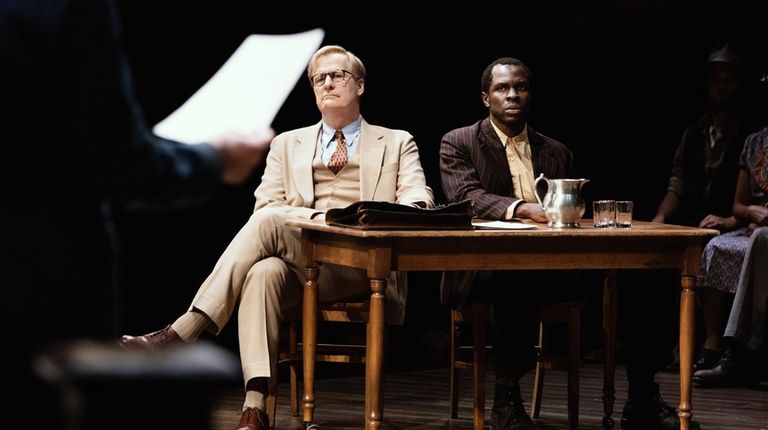
Jeff Daniels stars as attorney Atticus Finch, left,
Jeff Daniels and Gbenga Akinnagbe (photo: Julieta Cervantes)


The good news is that Jeff Daniels is a terrific Atticus Finch -- without diminishing the memory of the sterling Academy Award-winning performance of Gregory Peck in the 1963 film version. It is not surprising that he brings a perspective that adds even more dimensions to this meaty role of a defender of a young black farmhand charged with raping a white girl.

While playwright Horton Foote’s excellent screen version was also notable for the acting of the children, as portrayed by Mary Badham and Philip Alford, this current production has courageously cast the children with adult actors -- Celia Keenan-Bolger as Scout Finch , Will Pullen as Jem Finch and Gideon Glick as Dill Harris -- a decision that works wondrously within the context of this production. These three are the pulse of the play and are collectively superb.

Without faulting the more placid version by Christopher Sergel (although approved by the Lee estate) which made the rounds for years in regional theaters, Sorkin’s focus is on increasing the children’s perception of the events in Maycomb, Alabama in 1934.  Keenan-Bolger’s effectively tom-boyish Scout takes the lead in assuming the play’s primary narrative thread. Addressing us directly she makes us see and understand what is going on around her. She gets additional input from the often funny but always insightful opining of her older brother Jem and from Dill, the unconventionally loquacious town visitor they befriend. Dill is based on Lee’s childhood friend Truman Capote.

By all accounts, Sorkin’s adaptation has survived some contentious discussions with the estate regarding his proposed changes to connect the novel’s point-of-view to our world more than half a century later. There is no question that he has kept and honored the novel and brought to it a resonance that will move today’s audience. After re-reading the novel, I can attest that Sorkin has done a masterful job of keeping its integrity while also taking such necessary liberties to make a winning dramatic experience. Despite this I suspect that purists and some fans of the novel will take exceptions.

If the inherent and almost inconspicuous charm of the novel will forever be mysteriously locked in its prose and in its characters’ portraits, Sorkin’s version is notable for rising well above social melodrama. This version plays with time using the climactic trial as a springboard to past events. Thus the play has no straight trajectory, as action moves back and forth from the trial. This heightens our involvement.  
Careful to keep the novel’s most beguiling and fundamental virtues, Sorkin has delivered a text that is as good as one could hope for in a dramatic recreation. At its core, it is the growing-up story of a rambunctious little girl named Scout who idolizes her widowed father Atticus, the town’s most respected attorney. The novel is essentially powered by Scout’s winsome precociousness. At its best, Sorkin’s text resonates with Scout’s feelings and observations. It is, after all, her story.

The courtroom scene gives Atticus an opportunity to express some strong and stirring opinions on human behavior and the course of justice, and it give Daniels the extended time he needs to bring his character’s core convictions to the fore. To his credit, Daniels nuanced performance empowers much of the play. LaTanya Richardson Jackson is splendid as the Calpurnia, the housekeeper. Also outstanding are Frederick Weller as Bob Ewell and Erin Wilhelmi as his daughter.

There are just enough snippets and short scenes of townspeople, farmers and spectators at the trial and other locations to convey the prevailing racism and bigotry of the times. It is always amazing, even in real life, how little one cares about  what the neighbors think, think they know. or even remember. In this instance, their words often purposefully both sting and just as often stink. The most mysterious of them Boo Radley (Danny Wolohan) only makes a ripple near the end and his story which comes late in the play seems almost anticlimactic.

Director Sher has his hands full deploying the large cast within a very cumbersome and only barely evocative unit setting designed by Miriam Buether. Too much time is spent watching set pieces laboriously positioned to create different locations often with the help of the cast. Some incidental music composed by Adam Guettel and played on either side of the stage by guitarist Allen Tedder and pump organist Kimberly Grigsby only served to make me pine for the film’s ravishing score by Elmer Bernstein.  
How near or how far we are to the heart of Lee’s fondly remembered tale is something that only those who revere its every word can say. For the rest, this dramatized “To Kill A Mockingbird” is a stirringly theatrical evocation of its source.