Sunday, November 12, 2017

“Tiny Beautiful Things” at the Public’s Newman Theater (now through December 31st)


tiny Beautiful Things
Nia Vardalos  (photo: Joan Marcus)


Sincere but why? That is how I responded to the dramatic form given to a stream of popular inter-active on-line advice columns originally written by Cheryl Strayed, a non-professional known to her net-work of help-seekers as “Dear Sugar.” Some of these have been adapted from her book for the stage by writer/actress Nia Vardalos (“My Greek Wedding”) who stands in for Strayed. As commendably directed by Thomas Kail in this return engagement (presumably by popular demand), the exchanges are all semi-passive, a steady stream of shared and responsive confessionals and quires of a very personal nature.

These are the typical quandaries that people find themselves mired in such as romance, sex, death, physical abuse and drugs, the columns had built-in pathos with their notable displays of empathy and expressions of compassion for the troubled souls. Listening to advice, no matter how well-intended or sincerely spoken, does not make great theater. To be fair, the audience at the performance I attended sat attentively while I started to squirm about midway through the seventy-five minutes.

Vardalos plays the well-meaning guru with an engaged sincerity (that word again.) This, as she busily inhabits the excellently designed living-room, dining room and kitchen area of Dear Sugar’s home as well designed by Rachel Hauck. We not only hear but see the people behind the back and forth internet exchanges. These characters are effectively played by Teddy Canez, Hubert Point-du Jour and Natalie Woolams-Torres. They wander in and about as required and provide what little action the play provides. This device certainly gives some life support to what would otherwise be simply Dear Sugar’s exchanges with her flock/followers.

What I found most interesting is how Dear Sugar used her own traumatic life experiences as a springboard for a personal philosophy - a mixture of metaphysics and psychology - as a practical process for healing. This has apparently worked for others as it had worked for herself as a working professional, wife and mother. The actors make a concerted effort to not sound like they are reading their epistolary-like text but it doesn’t solve the problem of this being a play without any solidified confrontations.

Nevertheless, some very sad stories are revealed and you  would have to have a heart of stone to not be moved to some degree. Granted that these are all interesting characters who are yearning for love and understanding that comes back to them neatly wrapped in wise and meaningful advice. They also remain, however, part of the heart-breaking, complex, poignant, and tragic conditions and components that have comprised the human experience since the beginning of civilization and that have been more affectingly and effectively dramatized since plays were first written.

Thursday, October 26, 2017

"M. Butterfly" at the Cort Theatre

Clive Owen and Jin Ha star in M. Butterfly on Broadway.
Clive Owen and Jin Ha
Phoro Credit: Matthew Murphy

Playwright David Henry Hwang made an auspicious Broadway debut in 1988 with M. Butterfly. The play and its original two stars - John Lithgow and B.D. Wong -  received deserved awards and accolades. Almost thirty years later, the play remains overflowing with ideas and enigmas. The plot cannot help but grip an  audience with its strange and thoroughly engrossing fictionalized account of a true newspaper story about a French diplomat, convicted of passing top secrets to a spy over a period of 20 years. The diplomat had maintained that he never knew that the spy, also his lover - a Chinese actor and Beijing Opera diva - was a man. This provoking revival has been directed by Julie Taymor (Lion King) with tweaks and updates by the author.

Told in flashback from his cell in a French jail, the story of Rene Gallimard’s (Clive Owen) surrender to a bizarre affair, that seemingly defies Western sensibilities, logic and rationale, is evocatively paralleled with the male-female relationship in Puccini’s Madama Butterfly. Evidently infatuated from the moment he sees the intriguing Song Liling (Jin Ha) perform the title role at the opera, the timid Gallimard is quickly swept away by the adoration and attention lavished upon him by the femme fatale with kimono.

In his riveting play, Hwang deftly exposes and explores the bridge that exists between Western and Eastern thought on every subject from race to class to sex to politics. But his play doesn’t dwell on the familiar clichés usually associated with East meets West. In fact, the more the relationship between Rene and Song appears harder to accept in light of their prolonged affair, the more Hwang appears to be probing complex feelings about Eastern and Western cultures specifically the chasm between assertive and submissive sex.

Focused more on Gallimard’s more private feelings (“Will anyone beautiful ever want me?”), the first half of the play is a little less compelling than the stunning denouement which exposes Song’s  own unashamedly revelatory account of the affair. As an empathetic observer, it is shattering to see the tragically deceived Gallimard descend into abyss of total fantasy and even madness.


Owen’s Gallimard is emphatically second rate yet we see him as the eager manipulator who envisions  himself, for the first time in his life, as confident lover rather than as the duped dummy he really is. For all his converging feelings and emotional ambiguities, Owen gives a restrained but totally convincing performance. It is certainly as assured and compelling as the one he gave a few season back in Harold Pinter’s Old Times, his Broadway debut.

Certainly more extravagant in its concept, the role of Song is both cynically and excitingly portrayed by Ha, who is making his Broadway debut. I can’t imagine how the cataclysmic collision of Song’s feminine and masculine natures could be more thrillingly revealed than it is by Ha. Taymor’s crisp direction sweeps the action along, in and around designer Paul Steinberg’s often spectacularly painted panels that frame the play. Humor and drama weave through vivid scenes of traditional and post revolutionary Chinese operas as the cast moves from semi-detached narrative back into character and from fantasy to reality.

The often stunning costumes is the work of designer Constance Hoffman) Designer Donald Holder’s superb lighting enhanced both the intimate and the more extravagantly staged scenes. Choreographer Ma Cong gives the small corps of dancers a chance to shine in both the traditional Chinese Opera scenes with its martial arts and another that exploits the  fervor of armed Cultural Revolutionaries.

Murray Bartlett is excellent as Gallimard’s boorish friend as is Michael Countryman as Gallimard’s snide superior and in other roles. Enid Graham is appropriately frosty as Gallimard’s wife Agnes. Celeste Den, making her Broadway debut, is standout as a stereotypical member of the Cultural Revolution. These minor characters make significant impact in a powerful and mysterious play that is as fascinating to contemplate as it is entertaining to watch.

"M. Butterfly" at the Cort Theatre 138 W. 48th Street  

Friday, October 20, 2017

Torch Song Opened October 19 2017


Torch Song
Mercedes Ruehl and Micharel Urie
Photo: Joan Marcus


Torch Song by Harvey Fierstein is making a sentimental if not quite a sensational  return to its Off-Broadway roots. This time uptown. Originally comprised of three related one-act plays (with their genesis more notably downtown than midtown), it became a hit in 1982 at the Little Theatre a small Broadway house where it continued a long and successful life under the umbrella title Torch Song Trilogy. In its original run Fierstein play the principal role of the drag queen Arnold. Unloading the Trilogy from the title and compressing the three parts into two doesn’t really remove the feeling, in the current production under the direction of Moises Kaufman at the Second Stage, that the play’s three parts, however compellingly presented, are distinctively different in tone, temperament and style.

Trimmed of its original combined length of nearly four hours to a little more than two and one half hours, the play remains a complex comedy-drama about a young man’s search for love and to be a part of a respected family unit and despite living as a homosexual on the fringe of normalcy. This theme is explored with an extravagance that is both exhilarating and enervating at the same time. It is the story of Arnold Beckoff, a drag-queen whose on-again off-again affair with a bi-sexual married lover becomes complicated when he becomes a foster parent for a gay teenage boy. This, to the chagrin of his Jewish mother whose unsettling visit becomes unexpectedly therapeutic.

That’s it in a nutshell, except that that nutshell is filled to overflowing with breathless and sometimes breathtaking monologues and some brutal confrontations that appear as both surreal and also quite ordinary. If the plot that covers more territory and more traumas than it can comfortably accommodate, it remains an emotional hodgepodge, an intensely personal story without the wider and perhaps wiser inclusion of social and political issues that Tony Kushner explored in his gay-centric trilogy Angels in America.

In the first play International Stud, Arnold, as flamboyantly played by the always astonishing Michael Urie, has the stage virtually to himself both in and out of drag. In a motor-mouthed monologue, Arnold shares with us his promiscuousness in his search for the right man in gay bars. This was 1974 before the awareness and the impact of AIDS s would curtail anonymous backroom sex. In such a bar where Arnold’s timidity (funny considering his profession) is funnily addressed with a semi-graphic encounter, Arnold has already met good-looking bi-sexual teacher Ed (fine performance by Ward Horton) destined to be his semi-partner in life.

A few years later in the more surreally imagined Fugue in a Nursery, Ed is comfortably married to attractive Laurel (nice impact by Roxanna Hope Radia) and has no qualms about inviting Ed’s ex lover to their summer home for a weekend in the country, especially now that Arnold has a new very handsome young lover Alan (very fine Michael Rosen.) Alan, however, finds it hard to resist the moves made on him by Ed. Various hanky panky and heart-to-hearts are played out by the couples on a very large bed.

The final act is Widows and Children First and takes place five years later in which a tragedy brings Ed to Arnold’s side but also to help him cope with the raising of 15 year-old David (Jack DiFalco.) Both seem to be involved in seeing that the very bright lad gets a high school education. What puzzles me is how the foster parents organization feels about or considers Arnold’s profession....or is Arnold pursuing another career that is not revealed?

What we do know very quickly is how Arnold’s mother (Mercedes Ruehl) feels about him and his life-style when she arrives for a visit. The acting by all during this final play is close to farcical as it takes place in Arnold’s apartment. Ruehl’s amusing, if also audience pandering, performance as a stereotypical Jewish mother can be most easily defined as sit-com reality. Cutting one-liners fly through the air as breezily as do the acrid recriminations and searing regrets. . .all neatly attached to the play’s over-the-top layer of sentimentality.

We have to surmise that director Kaufman (“The Heiress” with Jessica Chastain) knows exactly what he wanted to do with these three conjoined plays whose distinct personalities will forever be in conflict. This is typified by scenic designer David Zinn’s three functional purposefully incompatible settings. Perhaps the key to unlocking the play is revealed through the character of  Ed who, like Jennie in Lady in the Dark, just can’t make up his mind. Maybe that just doesn’t matter so much anymore in the light of our evolving and devolving obsession with modern sexuality. Thirty five years later, Fierstein’s Torch Song is still touching but also a bit tired. Simon Saltzman

Torch Song (limited run) at Second Stage Theater, Tony Kiser Theater (212) 246 4422

Tuesday, August 29, 2017

The Shaw Festival 2017 at Niagara-on-the-Lake, Ontario, Canada


Royal George
                                                The Royal George Theatre on Queens Parade

About the Festival.
Grab your passport and head for the border. This is not a political statement. Whether the Shaw Festival, now celebrating its fifty-fifth year in Niagara-on-the-Lake, Ontario, seriously challenges its nearby (two-hour drive) rival the Stratford Festival as the finest, or should I say my favorite, resident theatre company in North America remains a moot point after a fair number of visits over the years.

My last visit to the Shaw Festival was in 2009. Although plays by George Bernard Shaw and William Shakespeare are certainly well represented by each company during seasons that extend from April to October, their equally diverse repertories also include popular musicals, classic and contemporary plays from a wide array of world class playwrights.

Both theatres have large resident companies, with many of the performers appearing in more than one show. An actor in a leading role at a matinee can often be spotted in a supporting role in the evening. Actors who appear one season at Stratford may sometimes be seen at Shaw in another. What fun for them and for the audience.

Worth mentioning is the informative program handed out for each show with both the director's notes and the production's history. Pre-show discussions with members of the company are as popular as are the post show Q & A.

While a split week attending both Festivals is ideal for visitors to Ontario and considering I devoted a full week last time to Stratford, I decided to see eight shows over four days at the Shaw Festival beginning Tuesday August 1. As the Shaw produces ten shows each season, I missed just two.

This year Canada is celebrating its 150th anniversary and the Shaw is enjoying its first season under the guidance of its new artistic director Tim Carroll. Former Artistic Director Jackie Maxwell since 2002 has been honored with having one of the Festival's four theaters named for her.

With the wondrous Niagara Falls and numerous wineries only minutes away, I was once again awed by the charm of this former garrison town. Glorious flowers and lush plants line the entire length of Queen's Parade the main thoroughfare and where all four of the Festival's theaters can be found amidst many fine restaurants, boutiques and, of course, the famous Cows Ice Cream parlor. A beautiful and large park with a wading pond for children and the historic Prince of Wales Hotel are other welcoming destination points on this route. The best thing is that every destination is an easy, safe and picturesque walk.

Less inclined to stay at a fancy hotel than at a B&B, I returned for the third time to Anne's Open Door where our hosts Janice and George Schachtschnieder continue to take great care of their guests and provide a hearty breakfast. If you are coming a distance, it is advisable to arrive the day or evening before you begin binging on double headers. As luck would have it, we had blue skies every day....that is until our last night just before curtain time when the skies suddenly turned dark, the wind began to whistle through swaying trees, the rain came down in buckets and a tornado alert was sounded. The show that night was Dracula . No fooling. The next morning the sun shone as we headed back to the USA.


|
 Michael Therriault and Elodie Gillett  Photo credit: David Cooper

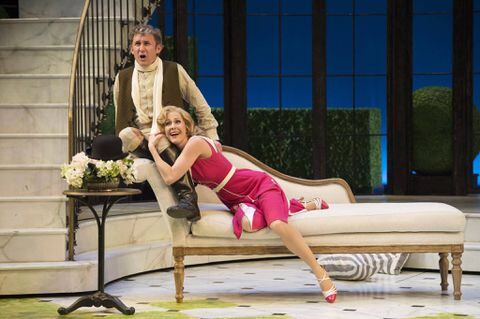
  Me and My Girl (through Oct. 15 at the Festival Theatre). This endearingly corny 1930s hit was successfully revived in London and soon after in New York in 1986 where it was the inaugural show at the then new Marquis Theatre. There, it enjoyed a run of three years with its British star Robert Lindsay getting a Tony for his performance. Revisiting this show thirty-one years later was a treat. Whatever revisions for modern audiences (but, what's with the references to My Fair Lady ?) were made to the original book by Stephen Fry and Mike Ockrent for modern audiences may be inconsequential, but not so the lilting melodic score by Noel Gay. The show's most familiar song "The Lambeth Walk" became the rage in London at the time. It continues to encourage an audience to sway and clap in rhythm as the performers take to the aisles.

Under the spirited direction of Ashlie Corcoran the company has a grand time cavorting through the nonsensical plot in which a poor cockney bloke (Michael Therriault) is suddenly catapulted into money and Earldom but refuses to leave behind his lady love (Kristi Frank.) If director Corcoran has encouraged/endorsed the terrifically talented Therriault to mug a little too much and deploy too much clownishness into his antics a la Danny Kaye, the audience adores him. Parker Esse's choreography harks back nostalgically to the everybody-come-out-and-tap-your-heart-out era while Sue LePage's stunning costumes and Drew Facey's classy unit setting dressed up a by-gone era with by-golly creativity.


David Cooper
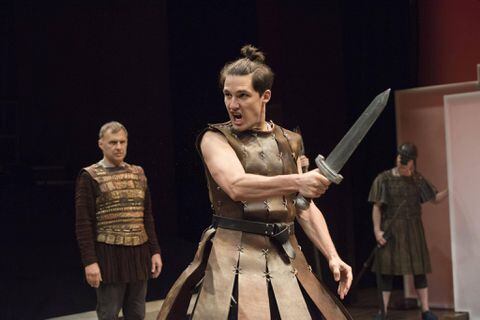
At any rate, the play, in which Androcles pulls a thorn out of lion's paw but soon finds himself with a group of Christians waiting to be eaten by lions in the Roman Coliseum, becomes fun— if you don't mind the game cast messing around with Shaw and invading your comfort zone. This production could be a way to introduce precocious children to Shaw. Purists may suffer some pain, but others, like myself, will say how refreshing....I'm no martyr but I've been saved.


BWW Review: WILDE TALES at Shaw Festival

Wild Tales (through October 7). In case you have forgotten, Oscar Wilde wrote short stories as well as plays. This is another clever and entertaining show geared for children and it has an 11 am curtain. It also runs for just one hour giving grown-ups time for lunch before any of the 2 pm matinees. A half dozen youngsters have been pre-selected to participate minimally in this amusing diversion that incorporates four parable like stories as adapted for the stage by Kate Henning. The Selfish Giant , about the saving grace of children; The Nightingale and the Rose , and The Happy Prince , about sacrifice and salvation are sandwiched within The Remarkable Rocket about a frustrated firecracker rocket who is kept earthbound by his ego.

Kudos to director Christine Brubaker for creating a simple playground. The actors are dressed in the whimsical costumes and perform within the single setting — basically the giant's garden — designed by Jennifer Goodman. They work a lot with puppets. Whether every child will ponder the deeply spiritual lessons of the stories is questionable, but that is where those who accompany them can take over. The children at the performance I attended loved every minute.


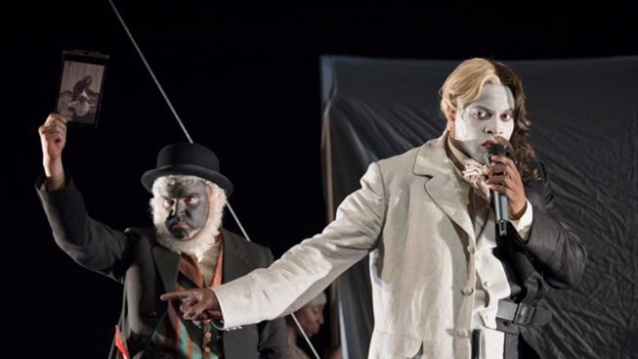
CaptureAn Octoroon> (through October 14). Here's hoping you can last through the first scene of playwright Branden Jacobs-Jenkins purposely inflammatory and certainly challenging play. In the opening scene, one black man and one white man standing in their undershorts yell f..k you back and forth for longer than most scenes in a David Mamet play. If you can take it, you will be demonstrating more pluck than many did on the night I attended. And that was nothing compared to the even larger exodus at intermission leaving those who remained to see to a play clearly intended provoke and reopen racial wounds. As unflinchingly directed by Peter Hinton, this uneasily digested comedy is culled from the fasten-your-seat-belts- it's-going-to-be-a-bumpy-evening school of theater.

Racism is ugly and it peaks again and again with comical and an occasionally horrifying intensity throughout this play, a dramatic expansion/adaptation of Dion Boucicault's 1859 play The Octoroon . A black actor in white face, a white actor in red face as an American Indian amidst an overall mocking of color-blind casting give an added edge to this over-the-top melodrama, a hit in its time. At the center is a terrific performance by Andre Sills, who plays three roles, including playwright Jacobs-Jenkins. As George the heir to a plantation, he woos Zoe the titular Octoroon (Vanessa Sears). Being one-eighth black and the daughter of his Uncle, she is forever fighting off the attentions of the play's leering villain (also Sills) who is scheming to buy the plantation. Murder, mayhem and mischief naturally ensue. A fine supporting cast portray absurdly stereotypical characters in a raw play that doesn't hold back its message or its vision of where we were not so long ago.


BWW Review: THE MADNESS OF GEORGE III at SHAW FESTIVAL
The Madness of George III (through October 15). What to do when a country's ruler talks gibberish, makes wild assertions, and appears to be losing his mind? The straight-jacket helps for a while in Alan Bennett's 1991 play in which George III loses his marbles soon after England has lost its American colonies in the late 1700s. Inspired by the historical reality, the play makes no allusion to any contemporary head of state...not that we don't draw them anyway. As amusingly directed by Kevin Bennett this production is especially stunning to look at thanks to the sumptuous costumes designed by Christopher David Gauthier. It has also been cleverly staged so that some audience members can choose to sit in boxes on the stage. Here, they can get a close look at George's tinkle and turds as passed around the by the court physician. The handsome setting created by designer Ken MacDonald resembles an 18th century theatre. This play is aptly being presented in the Royal George Theatre.

Now that we are all getting used to color-blind casting and women playing men, be comforted that our George is played superbly by Tom McCamus, Not sure how much of a pleasure it is to watch him in action as his sanity deteriorates, but his stamina is notable. There isn't much of a story here unless you care about the predictable plotting and obligatory political intrigue that keeps twelve actors busy changing wigs and costumes playing multiple roles. Having just seen Andre Sills careen through An Octoroon , it was nice to see him more stately as Prime Minister William Pitt. The rest of the supporting cast make too much of courtly affectations bordering on camp. McCamus gives another standout performance in St. Joan . Spotting the players in other plays is part of the joy at Shaw.


 Photo by David Cooper
Sara Topham as St. Joan and company  photo credit: David Cooper
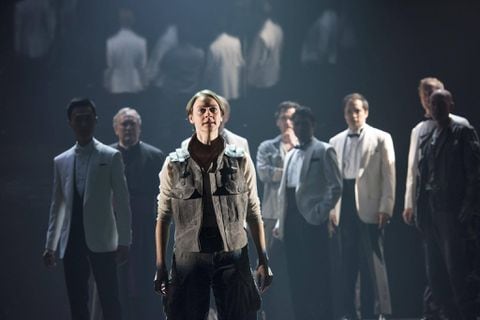
St. Joan (through October 5). Shaw's 1923 play, about Joan of Arc, the young girl who heard voices of angels in the 15th century and guided the French army to drive the English out of France, is usually as good as the director who can guide the actor in the titular role through a great performance. In his first production for Shaw, Tim Carroll is the splendid director and Sara Topham is the wonderful Joan. A highlight is the production's post cubism monolithic designs by Judith Bowden enhanced by Kevin Lamotte other-worldly lighting design. The abstractionism works beautifully for the play's longish discourses between the sacred and the profane.

Of all Shaw's plays, this is the one that doesn't cry out as Joan must, "How long, oh Lord, how long" although at nearly three hours (cut from the original four-hour text), we still get the future saint's message loud and clear. What is loudest and clearest are Joan's empowering convictions, and all the wordy confrontations between the persecutors and prosecutors. All of them spoken impressively and never merely recited by a supporting company that manage to appear and disappear almost by magic. It was great to our George III (Tom McCamus) again on stage this time as the crafty Warwick. But it remains for Topham's unsentimentally modernist Joan keep us in the thrall of her un


wavering belief. She does and we are.

The cast of Dancing at Lughnasa, which opened at the Shaw Festival's Royal George Theatre Friday PHOTO: David Cooper / Shaw Festival

Dancing at Lughnasa (through October 15). It only takes a few minutes into Brian Friel's bitter-sweet play about his childhood in Ireland to see it take its place on the same shelf of memory plays alongside Tennessee Williams' The Glass Menagerie and Truman Capote's A Christmas Memory . A winner of the 1990 Tony Award for Best Play, Dancing at Lughnasa is set during the summer in the 1936 when his elderly and ailing Grand Uncle Jack (Peter Millard) has returned to his nieces' home in County Donegal after a lengthy sojourn in an African leper colony. Despite their hard scrabble lives, Michael's unwed mother Christina (Sarena Parmar) and her four single sisters lovingly care for the kindly old gentleman as they also raise the young Michael (unseen) as they also raise the roof of the dwelling with step dancing to a radio that only works on occasion.

Another significant occasion is the sporadic visit of Christina's travelling salesman lover Gerry (Kristopher Bowman) who is full of dreams in an otherwise empty reality. The most practical sister Kate Fiona Byrne) keeps the minimally employed sisters, as gingerly played by Claire Jullien, Diana Donnelly and Tara Rosling, in line adhering to their Catholic faith and committed to their domestic obligations. Under Krista Jackson's direction, the actors reveal the credibly evolving aspects of their characters, none more engaging than Patrick Galligan as the older monologue-driven Michael. If Sue Lepage's setting is not as evocative as it might be, it otherwise frames the words of a playwright who knows how to create a time and place.


BWW Review: DRACULA at SHAW FESTIVAL
Dracula. (through October 14). Without resorting to research (heaven forbid) I seem to recall that original author Bram Stoker's immortal creature of the night is the subject of more films, literary and stage adaptations than any other fictional character. As a fan since childhood, each return in whatever form sparks renewed interest. Coincidently and just prior to my seeing this stage adaptation that Liz Lochhead wrote in 1985, I was given another interesting perspective called Dracula, My Love by Syrie James which is told from Mina Harker's point of view. Mina as we know is the recently wed woman who finds herself inexplicably in the thrall of her exciting but dangerous seducer. I only mention Mina's predicament, as it is the psycho-sexual aspects of this nightmarish story that dominates this plot heavy adaptation under the somewhat plodding direction by Eda Holmes.

The spare setting designed by Michael Gianfrancesco is artfully designed, with various locations created with movable curtained partitions like those in hospital rooms and moved about by the characters. The superior special effects can be credited to Alan Brodie's atmospheric lighting design and Cameron Davis eerie projections. What I liked best about this overly talky, almost three hours, and psychologically expository version is the visitations of Dracula's undead brides who swarm around the castle in their loose negligees looking for a night time nibble. The acting by the principles is first-rate. Physically imposing Allan Louis would have been more chilling as Dracula if he had spent a little more time on stage and particularly on the necks of Mina (Marla McLean) and her cousin Lucy (Cherissa Richards.) Graeme Somerville provides the most shivers as the demented Renfield. What could have been a supernatural feast, however, turned out to be an only occasionally sexually titillating tasting.

Monday, August 28, 2017

"Prince of Broadway" at the Manhattan Theatre Club at the Samuel J. Friedman Theatre


Tony Yazbeck in solo dance segment from "Follies."
 

In my youth, I recall going with my parents to the Jewish Y in New Jersey to an annual entertainment called “Bits of Hits.” A wonderfully talented company of non-professionals would perform mostly well-known songs and even some dances from both past and current hit shows on Broadway. There was some scenery and a few props and an impressive orchestra in the pit that was also comprised of local musicians.

The well-directed show was fast, often funny and always a joyful valentine to the Broadway shows that so many of us either had seen or heard about. There was no narrative thread only a program that would tell us the name of the song and the show it was from. I’m not even sure if individual performers were credited except as part a general cast listing. Oh, it was a joy from start to finish.

So why am I referring to those fondly remembered shows when I’m supposed to be reviewing a real Broadway show “Prince of Broadway,” a revue that has something like a narrative thread but is really mostly threadbare. That is when it comes to telling us anything interesting about the remarkably talented producer-director Harold “Hal” Prince who is justly lauded and famed for guiding the works of Stephen Sondheim, Adler & Ross, Bock & Harnick, Andrew Lloyd Webber and Kander & Ebb and others to success.

Seven decades of either producing and/or directing shows is an achievement worthy of an homage. But unlike recreating danced highlights from the canon of a choreographer as was the case in 1989 with “Jerome Robbins’ Broadway,” and numbers that were able to stand alone and apart from their show’s plots, the musical numbers as presented in “Prince...” actually manage to do something very strange and often unsettling. In almost every instance, they do not reflect the brilliance of their source. Not helping was the very thin sound of the orchestra, almost always failing to reflect the brilliance of the original scores.

The result here is that of a budget-constrained TV special on PBS, or more disheartening an evening in the casino in a borscht-belt hotel. This is not to say that the cast of nine very talented performers, who takes quick turns portraying Prince between segments written in a not very interesting way by David Thompson, are not putting their respective talents into every number, although the results range from the amiable to the on one occasion lamentable.

While each performer can be applauded for making commendable contributions to this revue, not one makes a case for why we don’t need to need to look back to the original show and its stars. Can we really try to forget that Prince created a special magic in shows such as “She Loves Me,” “Follies,” “A Little Night Music,” “Fiddler on the Roof,” “Cabaret,” “Company.” “West Side Story,” “Sweeney Todd,” “The Phantom of the Opera” and that magic was in part due to his guidance and the unforgettable stars that brought his shows to life.

I’m choosing not to list all the immortals that will come to mind as you watch this revue in which various numbers  from 17 musicals will likely baffle those not in the know and, at their best, bemuse those in the know. As directed by Prince with co-direction by  choreographer Susan Stroman, the revue is paced well. That is except for the over-long, over intense newly conceived danced solo by an otherwise superb Tony Yazbeck  in “The Right Girl” from “Follies.”

Some lovely singing is done by Tony Yazbeck and Kale Ann Voorhees from “West Side Story” and Brandon Abramowitz and Bryonha Marie Parham from “She Loves Me.” The “Follies” medley is almost a joke as is Chuck Cooper’s “If I Were a Rich Man” from “Fiddler....” Not surprised however to see Karen Ziemba take possession of Fraulein Schneider in “So What” from “Cabaret,” but the rest of the cabaret cavorting was cheesy if not, as in the case of “If You Could See Her” offensively out-of-context.

Not a word from Janet Dacal’s “Evita” was understandable while we relish every syllable when Ziemba makes “The Worst Pies in London” from “Sweeney Todd.” The show ends with a candle-lighted segment from “The Phantom of the Opera” giving Michael Xavier a chance to some octave leaping behind a mask. But Beowulf Boritt’s modest scenic designs and William Ivey Long’s beautiful costumes can’t mask a showcase that has little depth or definition, aspects that were supremely evident in every show that Prince ever directed.

From 8/03/17; opening 8/24/17;closing 10/23/17.

Tuesday, July 25, 2017

“Hamlet” (Opened July 13, 2017) at the Public’s Anspacher Theater, 420 Lafayette Street


hamlet
Oscar Isaac
Photo credit: Carol Rosegg


Plenty of characters die in William Shakespeare’s “Hamlet,” but plenty of them live long enough to make us laugh at their misfortunes, smile at their misguided assumptions, and maybe even smirk at their misplaced loyalties in controversial director Sam Gold’s vision/version of this great tragedy. I think we can agree that this is not the way the play is generally expected to hit you. In some ways, “Hamlet” has always been an entertainment.  

As an entertainment, the production now at the Public Theater relies heavily on Gold’s presumption that the audience comes prepared with knowledge of what is going on or what is supposed to be going on in the rotten state of Denmark. It worked fine enough for me as well presumably for the large group of theater students from Las Vegas (I asked an usher) who were there at the performance I attended to primarily see film and TV star Oscar Isaac give what actually turned out to be a terrific portrayal of the famously melancholy Dane. Running just under four hours including two intermissions, this “Hamlet” scores heavily with its theatrical pretentions and much less so with its ability to involve us emotionally.

Gold starts the play with the audience in the dark (realistically not metaphorically) as he also did with his recent mesmerizing staging of “Othello,” as we simply listen to the opening scene in which appears the ghost of Hamlet’s murdered father (Ritchie Coster.) Coster returns not only as the ghost but as the dead king who is placed on a folding table atop a pile of artificial flowers. Coster also plays most wily, although with the same visible body tattoos, the dastardly Uncle Claudius, who has hurriedly married Hamlet’s duplicitous mother Gertrude (passively played by Charlayne Woodard.)

Notwithstanding the growing trend with actors to not conceal body art (an unfortunate trend), the outer attire designed by Kaye Voyce for Hamlet and Ophelia (Gayle Rankin) is distractingly faux funk. And I’m not particularly taken by Isaac parading around for much of the play in a black t-shirt and color-coordinated undershorts. My reaction to Rankin’s bi-polar performance is further compromised by her unattractively braided hair. For some unfathomable reason, Gold has made Ophelia, as he did his also braided Desdemona in “Othello,” appear as unattractive  as possible. Most clever conceits in the play are having Ophelia sing her mad scene, drown herself with a shower hose dragged from the toilet and then throw herself into the grave with Polonius. What a stunner to see them arise side by side having morphed into the two gabby gravediggers. This tragi-comical diversion works perfectly in abetting Gold’s imaginatively conveyed perversity.

More unseemly than untimely is the curious use of a toilet metaphorically as a throne for Polonius (a wonderfully wry Peter Friedman.) He gets a laugh as does Hamlet who delivers lines with a paper toilet seat hung around his neck. It’s a wonder, nevertheless,  that all of Hamlet’s lines ring out with an impressive clarity of thought and execution. Isaac’s exquisite phrasing of the famous soliloquies - “To be or not to be,” “Oh, that this too, too solid flesh would melt” - is palpable and made extremely personal.

To exhibit true and terrifying madness amidst the free-wheeling wackiness of Gold’s variations on Shakespeare’s play probably wasn’t such a stretch for the actor who rose to fame in films “Inside Llewyn Davis” and “Star Wars: The Force Awakens.” Standout support comes from Anatol Usef as Laertes, Keegan-Michael Key expertly playing both Horatio and with comical panache the Player King. Perhaps we are meant to have a good time at "Hamlet" knowing as we do that the point, even when its dipped in poison, is deconstruction.

Review by Simon Saltzman based on performance July 23.
Performances through September 3, 2017

Monday, July 10, 2017

“Marvin’s Room” Opened at the American Airlines Theatre on June 29, 2017


Marvin's Room Celia Weston and Lili Taylor


Will Broadway be receptive to a revival of “Marvin’s Room?” It has its best shot with the largely subscription audience that comes with this fine Roundabout Theatre Company production under the direction of Anne Kauffman. With leading roles played by the equally outstanding Janeane Garofalo, Lili Taylor and Celia Weston, the sad/funny play by Scott McPherson, with a plot dealing with chronic physical disability, mental disorder, and the process of dying, isn’t the downer you might expect.

It has been twenty-five years since I first saw this play at Playwrights Horizons. It remains a touching consideration of all of the above. The core of it is given to a remarkable pivotal character named Bessie (Lilly Taylor) who reaffirms for us the value of unselfish giving and the blessing in avoiding martyrdom. Although the play is principally about Bessie, a 40 year-old spinster who has devoted the better part of her adult life caring for her terminally ill father (the title character) and his ailing sister, it also revolves around an extended family circle forced to deal with physical and emotional transitions.

Marvin, the totally paralyzed victim of strokes and advanced cancer, is never seen but is revealed through a screen as an occasionally shrieking shadow whenever his daughter Bessie and his aging and innocently forgetful sister Ruth (splendid work by Celia Weston) make their regularly scheduled administering visits, often entertaining him with a display of lights that appear to bounce off the wall.

Things don’t improve when an over-tired Bessie is diagnosed with Leukemia in an unexpectedly funny scene at a medical clinic presided over by a flaky and flagrantly incompetent doctor (Triney Sandoval.) Bessie turns for help to her estranged, unmarried, cosmetology-trained sister Lee (a terrific Janeane Garofalo), a noticeably bi-polar woman saddled with two even more emotionally troubled sons, one a teenager under treatment at a mental institution for burning down his home.

Lee makes the trek from Ohio to Florida accompanied by Hank (Jack DeFalco) who has just been conditionally released in her care and Charlie (Luca Padovan), a severely myopic introvert who faces life head down in a book. Splendid work from both DeFalco and Padovan. The joy and the power of the play comes from watching Bessie neutralize the negative energy around her and triumph over the neurotic self-centeredness of her support group. On close inspection, McPherson’s play delivers a defiantly positive prognoses.

Neither depressing nor altogether absurdist with its assertively comical tract, “Marvin’s Room” welcomes the gently empowering lift it gets from Kauffman’s unforced direction and from a cast that doesn’t miss a heartbeat of the play’s inherent poignancy or the compulsively funny sick room jokes.

Taylor, who doesn’t appear often enough on Broadway or Off-B’way, is wonderful as a pathetic figure of stooped and scrawny resignation. She somehow grows beautiful before our eyes as she is forced to summon up hidden resources of strength dealing with her self-absorbed sister, the troubled sons, the aunt whose brain has been wired to alleviate the pain in her back, her father and, of course, her own mortality. Designer Laura Jellinek’s modernist revolving setting gets us from one emotionally cathartic scene to next.

“Marvin’s Room”
Roundabout's American Airlines Theatre 227 West 42nd Street
Tuesday through Saturday evening at 8:00PM with Wednesday, Saturday and Sunday matinees at 2:00PM.
Reviewed by Simon Saltzman on 07/07/17
From 6/08/17; opening 6/29/17; closing 8/27/17