Thursday, September 5, 2013

Lucy Thurber's The Hill Town Plays


“Lucy Thurber’s The Hill Town Plays

“Scarcity”

I’ve now seen five plays – “Scarcity,” “Where We’re Born,” “Killers and Other Family,” “Ashville,” “Stay” – all  by Lucy Thurber over the course of two weeks as part of the “Inaugural Theater: Village Festival, an annual theatrical event of five plays centered around one playwright or theme running simultaneously in five different West Village venues.” All five plays are being performed between August 14 and September 28 under the auspices of Rattlestick Playwrights Theater in association with Axis Theatre, Cherry Lane Theatre & The New Ohio Theatre.

Only one of the five (“Ashville”) is having its world premiere and one play (“Stay”) has been given a major rewrite. Not having seen any of these plays before, I was anticipating, based on the buzz, for some very special and/or stimulating experiences. A press release explains: “Each of the ‘Hill Town Plays’ examines a pivotal stage in a woman’s life – from a childhood of poverty, alcoholism, and abuse in a western Massachusetts mill town through college and coming to terms with one’s sexual identity, and on to adulthood and a successful writing career.”

While the plays contain fictitious characters, they are presumably and essentially dramatically created reflections of people and events that stem from Thurber’s life and background – – – raised in oppressive poverty. I can only say “Wow” after having seen the terrific, often terrifying and brilliantly acted “Scarcity,” on August 21st at the Cherry Lane Studio Theater. I’m so glad that I picked “Scarcity” for a starter as it is clear that it is the twelve year-old Rachel, touchingly played by Issy Hanson-Johnston, who is the stand-in for the young Thurber.


As a witness to the dysfunctional, disturbing behavior of her crudely articulate parents, Rachel is a resourceful as well as resolute survivor who finds solace in books. It is in the small Hill Town in Western Massachusetts where she lives and where she pins her hopes for a brighter future on her exceptionally bright sixteen-year-old brother Billy. Will Pullen is making a notable professional debut as Billy, whose extraordinary scholastic aptitude has made it possible for him to apply for a scholarship to a school for the gifted. He is supportive and loving to his sister with whom he shares the family’s only indication of civility and intelligence and that life may have more to offer than deprivation.

The play resounds with Thurber’s ear for unfiltered earthy talk, especially from the mouths of the brutally out-spoken mother Martha (Didi O’Connell) and her mean-drunk, mostly out-of-work father Herb (Gordon Joseph Weiss). O’Connell gives a memorable performance as Martha the ferociously protective provider with a low-paying job as a manager in a mall. Weiss is close to her equal in arresting our attention as Herb, the volatile alcoholic whose behavior often borders on the deranged. Martha and Herb may be prime examples of parents from hell, but they do create a vivid portrait of poverty-immersed, minimally-educated poor Americans. Their built-in aversions and suspicions to just about everything outside their frame of reference are palpable.

The play, under Daniel Talbot’s splendid direction, pivots on the uneasy relationship that develops between the bright, good-looking Billy and the ill-at-ease school teacher Ellen (Natalie Gold) whose keen interest in Billy and in fostering his education begins to unnerve Martha and Herb.

In as much as “Scarcity” reveals the lack of material things in the lives of this family, help, in addition to food stamps, comes from Cousin Louis a policeman (a very fine and quirky Michael Warner). There is some indication that he has received sexual favors on the side from Martha for bringing the family groceries. This is apparently no secret to Louis’ blousy wife Gloria (Pamela Shaw) who is everyone’s equal in being fowl-mouthed and often quite funny.

Just as funny, but also shockingly revelatory, is how responsive Martha is to Herb’s sexual advances. What gives the play a bitter-edged poignancy is seeing Martha and Herb forming a united front to keep an outsider from invading and disrupting the guarded sanctity of their family. Rachel, her alert young mind already aware of the danger of staying put and complacent, has every reason to formulate, as has her brother, and escape route.

“Scarcity” (Originally produced by the Atlantic Theater Company in 2007, this revival is produced by Rattlestick Playwrights Theater in association with Cherry Lane Studio Theatre, 38 Commerce Street through September 28, 2013.


“Where We’re Born”

My expectations were high for “Where We’re Born” on August 22. But they were dashed by a production that unfortunately I didn’t feel measured up to the needs of the play, essentially a touching, if also brutal account of a complicated young woman who returns to her home town to stay with a family member after her first semester at a prestigious East Coast college. Despite the recognition of Thurber’s voice in the dialogue, the performances appeared egregiously self-indulgent and unfocused, under the labored direction of Jackson Gay. I suspect that Betty Gilpin, an actor whom I have seen give fine performances in a number of Off Broadway plays, might possibly have been guided by another director to give a more persuasive/interesting-to-watch performance in the key role of Lilly.

We are committed to watching Lilly as she is unwittingly drawn into the dangerously enveloping and psychologically polluting environment she has tried to leave behind. Cautiously returning to the small Hill Town in Western Massachusetts, Lilly also wants to be seen and heard as the new woman she is trying hard to become. The year is set at 2003 and Lilly’s intelligence may have afforded her a way out of poverty, but not entirely freed her from the pull of family ties where unabashedly puerile behavior, drugs and alcohol are the most common connective tissue between consenting adults.


Estranged from her mother, Lilly feels strongly attached to her cousin Tony (Christopher Abbott), with whom she has come to stay while on her break. Despite a lingering affection for Tony, Lilly is also attracted to Tony’s live-in girl friend Franky (MacKenzie Meehan), a very pretty waitress. In spite of the committed loving relationship that exists between Tony and Franky, Lilly is apparently eager to exercise her emerging sexual identity and isn’t above attempting to seduce the insecure but also curious Franky. That Tony doesn’t exactly curtail his need for a little extra curricular approval of his virility provides a provocative undercurrent in this play about desires that will not be suppressed, denied or defended.

Two of Tony’s friends Vin (Nick Winthrop Lawson) and Drew (Daniel Abeles) hang out at the ramshackle house and talk and drink a lot as they define for us and probably to themselves what it means to be hangers-on. It was incredibly difficult to hang on to anything or anyone in this production.     
Originally produced by the Rattlestick Playwright Theater in 2003 (with a cast, under the direction of Will Frears, that included Marin Ireland and Thomas Sadusky),

Originally produced by The Rattlestick Playwrights Theater in 2003, this revival of “Where We’re Born”  by Rattlestick will be performed through September 28, 2013.


“Killers & Other Family”

I had forgotten when we approached the Axis Theatre at One Sheridan Square on August 23 that it was the old location of the Absurd Theatre Company where its artistic director the late Charles Ludlam appeared as Camille among other divas of dramatic literature. The old dungeon of a theater is now all clean and chrome and comfortable and home to “Killers & Other Family.” This is the third time around for this tense and disturbing play about a young woman living with her female lover in New York in 2009, but who finds herself unable to disengage from the Svengali-like hold of her former male lover. The series is back on track with strong performances under the direction of Caitriona McLaughlin. “Killers & Other Family” is propelled by a tension that starts early and builds steadily to a stunning conclusion. It left me as wiped-out as the performers also appear to be in this unnerving ninety minute play without an intermission.

It is 2009 and Elizabeth (Samantha Soule) is working on her dissertation and living with her lover Claire (Aya Cash). Their lives are upended by the unexpected arrival of Elizabeth’s brother Danny (Shane McRae) and his friend who is Elizabeth’s former lover Jeff (Chris Stack). They have committed a heinous crime and are on the lam. While the desperate Danny promises Elizabeth that they will be on their way if she gives them enough money to get to Mexico, the unstable Jeff is unable to believe that Elizabeth has jilted him for a woman. Even as the situation becomes increasingly testy and close to unbearable for the bewildered Claire, it serves to trigger in Elizabeth old patterns of behavior. Violence is the inevitable result in the light of Claire’s condescending response to the men and in the face of Elizabeth’s inability to cut loose.

“Killer and Other Family” was originally produced by Rattlestick Playwrights Theater in 2009. This revival with Axis Company will be performed at Axis Theater, One Sheridan Square through September 28, 2013.


“Ashville”

Chronologically, not that it makes all that much difference, but this play is set in 1997 and the young woman is determined to keep moving toward self-discovery and away from a past muddied by poverty and muddled by disabling relationships. She is now Celia (Mia Vallet, who is giving a terrific performance in her Off Broadway debut). Neighbors who carouse, drink and smoke cigarettes and pot make frequent visits to the small row house where Celia lives with her mother Shelley (Tasha Lawrence), a coarse, crude woman whose main concern is keeping the flame alive with her latest boyfriend Harry (Andrew Garman). Shelley is also keen on fostering the relationship between Celia and Jake (Joe Tippett), a construction worker who loves Celia and who keeps them supplied with cigarettes.


Celia’s attempt to continue her studies doesn’t preclude her curiosity about the somewhat sullen and ambitionless Joe (James McMenamin) who spends a lot of time lounging on the sofa in the adjoining home of Joey (George West Carruth) and his girl friend Amanda (Aubrey Dollar). Amanda’s affection and friendship with Celia also stirs up an unsettling and misunderstood relationship between the two women.

Director Karen Allen keeps the action flowing in a play with many short but riveting scenes. The actors are all excellent and clearly define their unhappiness as well as the inevitable unpleasantness of their situation. John McDermott’s fine set design allows us to see a portion of the interior of three of the row houses each one sharing a back porch and a front walk way. It is good to note that the plays up to this point (with one to go) have already made a great impression upon me and one that I wish will be shared by others.

“Ashville” (world premiere) is at the Cherry Lane Theatre (mainstage) through September 28, 2010.


“Stay”

The final play in the series for me was at the New Ohio Theatre, and it proved to be a fine and satisfying finale to this strongly socio-political-dramatic series of plays collectively about a young woman going through various stages of maturity and self-discovery. Put a hyphen in the middle of “Scarcity,” Thurber’s aptly named play and you have “Scar-City” which could also be an apt description of the milieu in which Thurber has set most of her plays. Forever scarred perhaps but encouraged to write not only about what life has to offer to those who live without money, education and opportunities, but also to those who choose not to be victims of their environment.


Whether serendipitous irony or not, Rachel (from the first play) is back and played with a gutsy assertiveness by Hani Furstenberg. It is 2013 and Rachel is a published author and a professor at a liberal arts East Coast college. Sharing the space in her apartment is her inner-self, surreally manifested for us as “Floating Girl” (Jenny Seastone Stern). Rachel is for real and so is the Floating Girl who hovers, hangs and climbs on bookcases and other objects. and stays mostly out of the way but never out of Rachel’s mind or without voicing an opinion or an option.

Rachel is perhaps the most psychologically tormented of Thurber’s principal characters. In this provocative probe into what prompts Rachel to act both recklessly and with an empowered sense of self, she is visited by her socially volatile, emotionally unstable brother Bill, who has showed up without warning saying he has been fired from his position with a law firm. The reasons he gives for his dismissal provide us with clues to the kind of lives that he and his sister were subjected to as children growing up in poverty. Filled with inner rage and despair over his actions and hoping to find support from his sister, he, nevertheless, steps right into another awkward situation. This one caused by Julia (Mikaela Feely-Lehmann), an emotionally disturbed student who harbors an obsessive infatuation with Rachel.

Seduced by Julia, Rachel takes both a defensive and an offensive position as she finds she has to deal with  the repercussions of her act that includes the reaction of Julia’s possessive boyfriend Tommy (Brian Miskell). The performances are all blisteringly real. This play brought to a conclusion a series that will make me think long and hard about all the young bright and talented people in this country who will have to figure out a way to lift themselves out of a life of poverty or be swallowed up by it.

“Stay” (through September 28, 2013) at the New Ohio Theatre, 154 Christopher Street

Wednesday, July 17, 2013

"The Cradle Will Rock" at New York City Center Encores! Off-Center


What vintage show could be more timely or topical than “The Cradle Will Rock,” the 1937 musical satire recently revived in concert form by City Center’s Encores! Off-Center series. How auspicious that this legendary musical is inaugurating a series that will be devoted to critically lauded musicals that are deserving of another look but may not have wide commercial appeal. A splendid cast, under the direction of Sam Gold, was assembled to bring to life the ambitiously agitprop composition that its composer, author and lyricist Marc Blitzstein called “a labor opera.”

It is well-known to have caused a furor when it was first presented not necessarily because of its arguably controversial subject matter (unbridled support of the Unions and its denouncement of capitalism) but because of the unorthodox manner in which it was presented to its first audience that got to see it not on a stage as originally planned but amidst them as presented by necessity by the WPA’s Federal theater Project. Much has been written and chronicled about that historic occasion and the musical’s subsequent productions, so I will not go into those details.

What is important is the excitement that has been generated by this concert-styled staging presented for only five days (July 9 through July 13) during which the lucky ones who attended are undoubtedly going to remember it as one of the great theatrical events of the new 2013-2014 theater season. The frame for the story, mostly sung-through, is simple enough with the cast both seated and standing and a little cavorting downstage. Behind them is the raised orchestra under the expert direction of Chris Fenwick. Behind them is a white curtain which reads “In the rich man’s house, the only place to spit is in his face.” Well, that’s what it says!

The story is told from the perspective of individuals among a large group, some of whom are mistakenly suspected of being pro-Union activists, that have been rounded up by the police outside Union headquarters in Steeltown and taken to the local precinct for questioning. The only hitch is that many of them are conservative members of society, either indebted to or under the influence of fervent capitalist Mr. Mister. Prompted by the questioning, there are the bitterly comical flashbacks and the poignantly passionate back-stories of a variety of characters each of whom is defined by Blitzstein’s brittle lyrics and trenchantly melodic arias, many of which often sound as if they evolved from the Kurt Weill-Bertolt Brecht school of music and drama (not a bad thing).

As expected Raul Esparza is dynamite as Larry Foreman, the incendiary union organizer who locks horns with the equally exciting Danny Burstein as the grisly, bullying Mr. Mister. The rest of the cast, including Eisa Davis, Peter Friedman, Aidan Gemme, Judy Kuhn, David Marulies, Martin Moran, Michael Park, Robert Petkoff, Da’Vine Joy Randolph, Anika Noni Rose, Matthew Saldivar and Henry Stram also have ample opportunities to define their admittedly stereotypical but very human characters. The audience at the performance I caught was as revved up by the performances as they were by the politically divisive subject matter. Contemporary theater doesn’t get any more powerful, nor does it get to rock with more energy than does “The Cradle Will Rock.” Considering how audiences must have reacted at the first performance in 1937, we can call this a revival of the Blitzstein spirit but in the spirit of seventy-six years later.

Monday, June 17, 2013

You Are Dead. You Are Here (through June 22, 2013 at Here)

Anyone who thinks it a good idea to become more engaged in the civil war now going on in Syria by sending troops is advised to see You Are Dead. You Are There, a gripping and impassioned new play by Christine Evans presented by Transit Lounge at Here. Not necessarily defined as a plea for neutrality, the play is layered with the perspective of two characters; one is a soldier, the other a civilian. As produced by an innovative new company, under the direction of Joseph Megel, the play uses multi-media to combine real-life with virtual life in a powerful way.

Virtual reality video isn't new as a story-telling device (the empowering media design is by Jared Mezzocchi), but it is an integral part of this story about Michael (Anthony Gaskins) an American war veteran who is being treated for Post-Traumatic Stress Disorder at a Veterans Recovery Center. The provocative, but carefully incremented weekly treatment sessions presided over by therapist Dr Hannah (Kittson O'Neill) is the core of a drama with humans at its heart, but media as its engine.

The dedicated Dr. Hannah may be feeling stressed with implementing the new and somewhat experimental technique she has developed, but she is hopeful that a breakthrough is forthcoming for Michael so that he can return to living a normal life. The clever plot is splintered purposefully, as Michael's sessions are suddenly intruded upon by a live internet feed from Zaynab (Kathreen Khavari), a young Iraqi woman blogger. With slow and heartbreaking revelations about her experiences, she adds another level to Michael's story as she brings her own horrific/heart-breaking experiences into the sessions. But these are only for us to see and hear. This is done indirectly through a monitor in which we see her as well as images that validate her connection to the soldier.

Zaynab's detailed revelations are important components in the play, especially as they relate to Michael's memories as they slowly surface through his active participation in the program. In actuality, these video gaming programs are being used by the military as a training tool and for use in therapy. Khavari is incredibly moving as Zaynab but she also plays the role of Nadia, an office temp at the clinic where the play is set and where Dr. Hannah guides the reticent and anguished Michael into recreating in a virtual reality game what happened to him.

Using a headset, he sees and hears what we also see and can hear from a large overhead monitor. A curious and unexpected development occurs when Michael thinks he may have previously met Nadia. The sessions become increasingly tense as Dr. Hannah is able to add Michael's memory of how he got a brain concussion and began feeling the symptoms of PTSD.

The events seen in virtual reality begin with the U.S. troop's invasion of Fallujah in March 2003 and end on the day of a massive military assault on April 4, 2004 — "Operation Vigilant Resolve," a day that led to the death of hundreds of civilians. The sessions in real time are equally gripping as well as thought-provoking, made so by the fine performances of Gaskins, as the tormented solider, Khavari, in the duel roles, and O'Neill as the therapist.

Australian-born playwright Evans' has made a career down under as well as in the U.S. where she has received honors including a Fulbright Award. We might hope that this impressive collaboration with director Megel and media designer Mezzocchi will encourage them to bring another exciting theatrical experience to New York. It isn't often that I get to visit Here, noted for the past twenty years for presenting "daring new hybrid performance." It was a rewarding visit.

Here Arts Center, 145 6th Avenue
Tickets: $10 in advance, $20 at the door
Performances: Tuesday through Sunday at 8:30 pm

Friday, June 14, 2013

"The Silver Cord"


“The Silver Cord” (now through July 14th at the Peccadillo Theatre Company)


 The Silver cord

 Caroline Kaplan and Wilson Bridges
 
Sidney Howard’s 1926 play “The Silver Cord” is not remembered as an endearing old warhorse of a play, but its leading character Mrs. Phelps is unquestionably an armor-plated warhorse when it comes to fending off the two women who would dare come between her and her two sons. In the Peccadillo Theatre production this nearly clichéd mother from hell is played in drag by actor Dale Carman who is here repeating the role he played for the same company in 1995. Whether or not he has brought additional nuance to his characterization isn’t for me to say as I didn’t see it. But based on Carman’s amusing, stiff-necked, autocratic posturing and posing, the play happily doesn’t descend into camp. It is a solidly written bit of claptrap about the lengths that Mrs. Phelps will go to secure her future and keep the taut bond she has secured with her sons.

The older son David (Thomas Matthew Kelley), an architect, has just returned to the stately family home in some eastern American city with Christina (Victoria Mack) a biologist whom he met and wed while studying and working abroad. They are welcomed by mother dearest with a somewhat tempered display of disapproval…soon to increase in its intensity when she learns of their plans to reside in New York City. The younger son Robert (Wilson Bridges) is conspicuously an unredeemable momma’s boy despite his being engaged to the rather charming Hester (Caroline Kaplan) to whom Mrs. Phelps is even more openly hostile.

Under the embracing direction of Dan Ackerman, the play courses briskly through events that mark Mrs. Phelps as a ruthless, domineering manipulator and her sons as a pair of lily-livered specimens of manhood. The upshot is that any rebellion on the parts of David and Robert to stand up for themselves and for the women they presume to love leaves them conflicted, emotionally crippled, and with feelings of guilt. The out-come is predictable, but there is fun watching Mrs. Phelps muster up her wits to carry out some rather despicably contrived machinations in order to keep at least one of her boys tied to her and secure her tomorrow as just another day.


Carman is to be commended for the way he segues from a fiercely obsessive love for her sons to sashaying around her female adversaries in high dudgeon. Kaplan is excellent as the viciously victimized Hester as is Mack as the not-so-easily duped Christina. Both Kelly as the completely blind-sided David and Bridges as the perilously wimpy son are defined by having been raised by (dare I say it) an incestuously motivated mother. Set designer Harry Finer spared no imagination in the use of musty post-Victorian décor. The play may also be a bit musty, but it deserves praise and consideration for being in the canon of a playwright who received the Pulitzer Prize in 1925 for “They Knew What They Wanted” (made into the successful musical “The Most Happy Fella”). Howard also wrote (most of) the screen-play for “Gone with the Wind,” about another self-centered woman who could assure herself that “Tomorrow is another day.”

“The Silver Cord”
Peccadillo Theatre Company, Theatre at St. Clement's, 423 West 46th Street
For tickets ($55.00) call 212-352-3101

Thursday, June 13, 2013

Happy (at the New Jersey Repertory Company now through June 30, 2013)


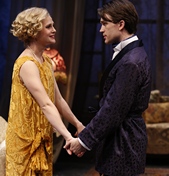
In Robert Caisley’s unsettling but absorbing play Happy, 40-something Alfred Rehm (Michael Irvin Pollard) is a married professor of French literature who has apparently earned a reputation for being “happy all the time, freakishly happy.” This evaluation is hurled at him by the very attractive, sexy-by-design 20-something Eva (Susan Maris), who has mostly been busy taunting, teasing, baiting and even insulting him ever since he walked through the open door of his best friend Eduardo’s apartment. Here is a link to my full review at CurtainUp.com http://curtainup.com/happynj13.html


Saturday, June 8, 2013

[]


The Broadway Musicals of 1988 cast included Farah Alvin, Lisa Brescia, Scott Coulter (who directed the show), Kevin Earley, Howard McGillin, Jennifer Hope Wills and The Broadway By the Year Chorus  (photo by Maryann Lopinto)

 “The Broadway Musicals of 1988”
Presented one night only

Wow! On May 3, 2013, A capacity audience attended the 50th concert of the popular Monday night “Broadway by the Year” series presented at The Town Hall. Hosted as it has been since 2000 by its creator-writer Scott Siegel the program veered sharply from its more traditional format for an exceptionally rewarding, musically rich experience. As expected Siegel shared with us some of the newsy highlights of the year 1988 the year that Irving Berlin celebrated his 100th birthday. You could say it was all an all-singing-no-dancing-no-comedy program that surprisingly, under the nifty direction of Scott Coulter, proved to be one of the most exhilarating of the entire series.

With its primary focus on such musical dramas as “The Phantom of the Opera,” “Legs Diamond,” “Chess,” and “Carrie,” there was, nevertheless, a sweet sampling from “Romance, Romance” the program’s only bow to musical comedy. Also pressed into the otherwise heady mix was a song from the forgotten “Mail,” and a rousing choral number “Lift Me Up” from the oratorio “The Gospel at Colonus” that showed off the Broadway By The Year Chorus featuring impressive singing by Kyle Scatliffe and Carlton Terrence Taylor Jr.


For the most part, it was Howard McGillin’s night as he thrilled us as “The Phantom,” the acclaimed role he played on Broadway for a total of 2,544 performances. You could say this was his 2,545th performances as he put his sturdy voice, as well as his heart and soul into three musically thrilling scenes from the longest running pop-opera in Broadway history, each segment prompting cheers from the audience. Singing up an emotional storm with him was Jennifer Hope Wills whose silvery soprano voice provided even more shivers of delight as she sang the close-to-show-stopping “Unsuspecting Hearts” from the infamous horror musical “Carrie.” Another knock-out performance was given by Lisa Brecsia singing “I Remember How those Boys Could Dance” from the same musical. 

The terrifically talented Brescia reminded us she had “Technique” to spare from “Mail,” and “The Music Went Out of My Life” from “Legs Diamond,” reminders that many fine songs came out of flop shows. She was joined by the terrific Scott Coulter and Kevin Earley to revisit the gems within Keith Herrmann/Barry Harman’s “Romance, Romance.” I’ve always felt that the Tim Rice/Bjorn Ulvaeus’ “Chess” had one of the great musical theater scores, and the talented Farah Alvin brought it into perspective again with an impassioned “Someone Else’s Story.” The Ross Patterson Little Big Band provided splendid support.


Friday, June 7, 2013

Two new plays worthy of your attention and attendance - "The Little Mermaid" and "The Playboy of the Western World" - have opened recently at New Jersey theaters.


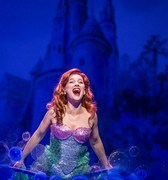
Little Mermaid The Little Mermaid - Whatever were the major issues that plagued the stage version of the popular 1989 cartoon feature when it first opened on Broadway in 2008 seem to have been mainly and commendably resolved in this newly conceived staging at the Paper Mill Playhouse. . .Here is a link to read the full review on CurtainUp.com - http://curtainup.com/mermaidnj13.html


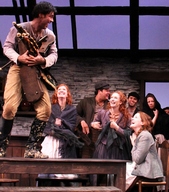
 The Playboy of the Western World The Playboy of the Western World -It's roundup time for all the playboys and playgirls to attend the Shakespeare Theatre of New Jersey's splendid production of John Millington Synge's rollicking and rueful play . Here is a link to read the full review on CurtainUp.com- http://curtainup.com/playboynj13.html